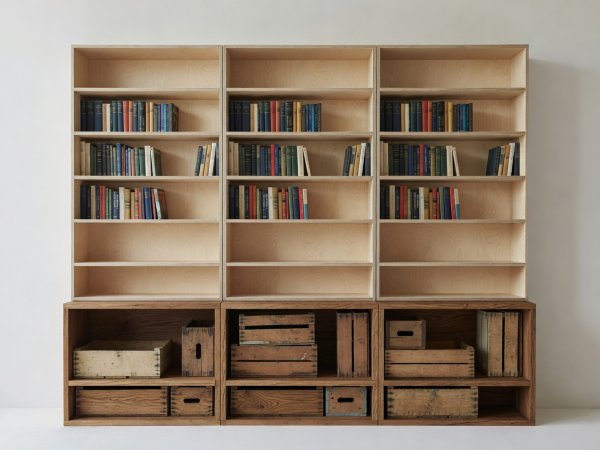
Most bulky wardrobes and sideboards are designed for a single frozen moment in a household’s life. Five years later—when a home library grows, a child arrives, or a room changes from dining space to studio—monolithic furniture either crowds the new layout or has to be discarded. Scandinavian modular storage solves this through standardised bay widths (typically 60 cm or 80 cm) and interchangeable depths (20 cm, 30 cm and 40 cm) that reassemble in under an hour.
Standard bay spans: 58–80 cm to prevent timber deflection under paper loads
Structural Principle · Stepped Depth
Shallow Above, Grounded Below
A wall covered from floor to ceiling in 40 cm deep shelving casts heavy shadows and makes a room feel narrower at shoulder height. By placing 35–40 cm deep shelves and wooden crates below waist level (0–85 cm) and stepping back to 20 cm deep shelves above 90 cm, you preserve full room width where people walk and talk while keeping heavy vinyl records, crockery and archive boxes safely low.
Dimensional Reference
Matching Shelf Depth to Household Contents
Before ordering shelves or crates, measure the three bulkiest categories you actually own. Over-sizing shelf depth wastes room footprint and creates dusty dead zones behind books.
Nominal Shelf Depth
Ideal Contents
Compatible Crate Size
Recommended Bay Width
18 – 22 cm
Paperbacks, hardbacks, CDs, spice jars, small framed prints, tea tins
20 × 28 × 12 cm half-trays
60 cm or 80 cm (supports up to 25 kg per plank)
28 – 32 cm
A4 ring binders, art monographs, folded knitwear, standard shoe boxes, 12-inch vinyl LPs
30 × 40 × 22 cm standard Euro-footprint birch crates
40 × 60 × 28 cm deep storage crates or sliding cabinet modules
80 cm with reinforced steel brackets
Joinery & Ergonomics
What Makes a Storage Crate Last Twenty Years
Box Joints Over Staples
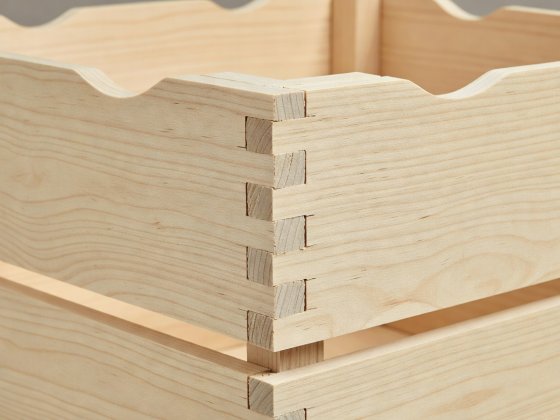
Cheap pine crates held together with thin wire staples twist and split the first time someone lifts fifteen kilograms of books or root vegetables. Look for machined finger joints (box joints) or birch plywood rebates glued with moisture-resistant PVA, paired with minimum 6 mm birch ply base panels set into a routed groove rather than tacked underneath.
Silent Runners and Replaceable Labels
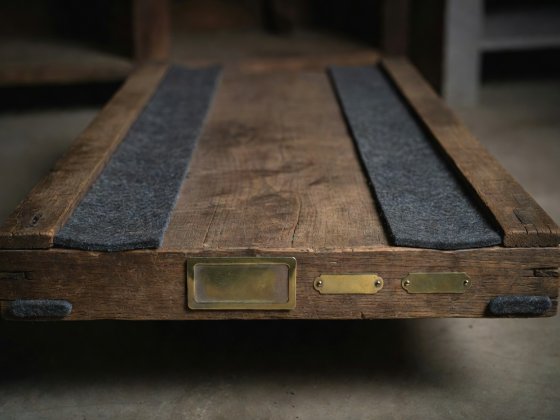
Adhering two 15 mm wide strips of 3 mm industrial wool felt along the bottom rails of every crate transforms an ordinary shelf into a quiet drawer system that will never scratch oiled timber. Pair each crate with a clip-on brass or painted steel label frame holding thick card—so when contents change from camera gear to knitting yarn, you simply slip in a fresh handwritten card.
Planning for Future Moves
One overlooked advantage of modular shelving and standardized wooden crates happens on moving day. Rather than emptying shelves into flimsy cardboard cartons, each wooden crate lifts off its brackets with its contents intact, stacks securely in a van via interlocking base rails, and slides directly onto the newly mounted uprights in the next flat.
Cookies on this site Some cookies are needed for the site to work. Others help us understand how it is used. You can change your choice later. More about cookies